
Finite Element Analysis of Composite Structures
Fiber composite structures enable high-performance, lightweight components. However, their layered architecture and anisotropic material properties pose particular challenges for numerical analyses. The finite element method is an essential key tool in the design and evaluation of composite structures. This course teaches both the theoretical fundamentals and the practical application for efficient modeling and analysis across different scales, with examples from industrial lightweight design and future maritime structures where simulation is central to safety, performance, and sustainability.
Course description
Lecturers: Prof. Dr.-ing. Weißgraeber and colleagues
Course content:
- Mechanics of composite materials and their anisotropic behavior
- Finite element analysis and Abaqus
- Buckling and stability analysis
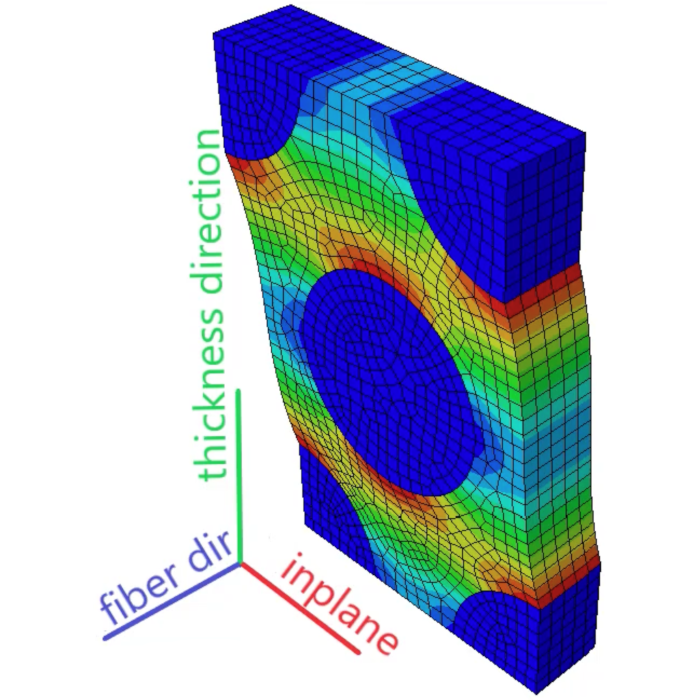
- Numerical micromechanics of fiber-reinforced materials
- Viscoelastic behavior of polymer matrix composite
- Modeling damage and fatigue
- Efficient FE modeling and use of programming interfaces
Credit points: 6
Pre-requisites for the examination: none
Type and scope of examination: written, 60 minutes or oral, 20 minutes or report and presentation, 20 minutes
Literature:
- Own lecture material
- E.J. Barbero, Finite Element Analysis of Composite Materials using Abaqus, 2023, 2nd edition, CRC press
- Further reading is specified in the course
Courses Overview
Summer semester:
- Lightweight Materials
- Experimental Lightweight Design
- Laboratory Practical Course in Materials Engineering
- Finite Element Analysis of Composite Structures (EN)
Winter semester:
- Fundamentals of Lightweight Design
- Lightweight Construction
- Adhesive technology
- Fracture and Damage Mechanic
- Composite Material Design (EN)
You can find our courses on StudIP.