
Fracture and Damage Mechanics
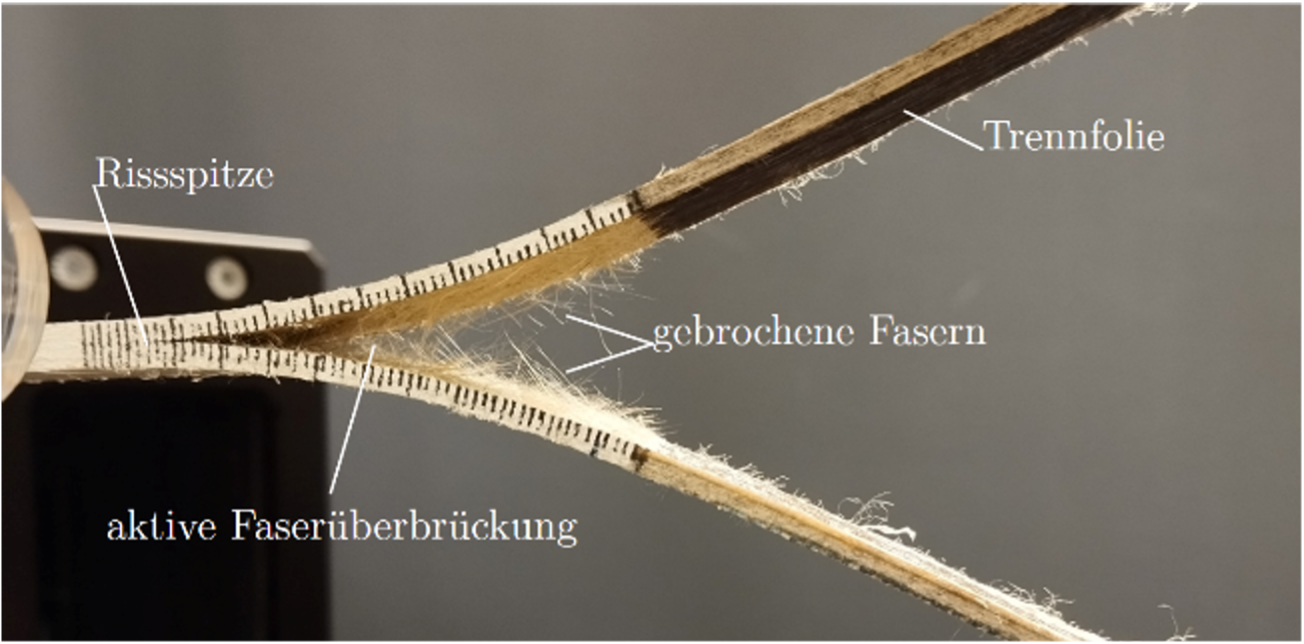
In lightweight construction, a thorough understanding of damage initiation and propagation is crucial for developing highly efficient structures. This is particularly true for multi-material construction methods, in which failure often occurs at interfaces, and for fiber composites, whose behavior is characterized by complex micro- and mesomechanical mechanisms that require physics-based approaches to failure development. The methods taught are not only relevant for classic lightweight construction applications, but also for applications in biomedical engineering, e.g., in the design of durable implant materials or highly efficient multi-material components.
Course description
Lecturer: Prof. Dr.-Ing. Philipp Weißgraeber and colleagues
Course contents:
Introduction to the fundamentals of fracture mechanics and the current state of science on new models and approaches
Experimental methods for characterizing crack and damage behavior
Extensions of fracture mechanics for crack initiation and failure prediction
Introduction to continuum damage mechanics and micromechanical approaches
Numerical methods of fracture and damage mechanics, including finite element implementations
Damage models for brittle and ductile materials as well as fiber composites
The course combines lectures and exercises to teach theoretical fundamentals, computational methods, and numerical methods in a practical manner
Teaching and learning methods: Lecture 4 SWS, tutorial 4 SWS
Credit points: 6
Type and extent of examination: oral examination
Courses Overview
Summer semester:
- Lightweight Materials
- Experimental Lightweight Design
- Laboratory Practical Course in Materials Engineering
- Finite Element Analysis of Composite Structures (EN)
Winter semester:
- Fundamentals of Lightweight Design
- Lightweight Construction
- Adhesive technology
- Fracture and Damage Mechanic
- Composite Material Design (EN)
You can find our courses on StudIP.